Articles / Records, patients, and staff
The 2026 HIPAA Security Rule Update for Dental Practices: What's Proposed and Where It Stands
No, it is not the law yet. The 2026 HIPAA Security Rule is a proposed rule, published for comment in January 2025 and still unfinished. If it is finalized, it would be the most significant change to HIPAA's security rules since 2013, and it would apply to your dental practice with no exemption for small offices. But a proposed rule binds no one, this one missed its own target date, and more than a hundred health care groups, the American Dental Association among them, have asked the government to withdraw it. Here is what it would change, where it actually stands, and what is worth doing now. The proposal touches the Security Rule specifically, while how all of HIPAA fits a dental practice covers the rules in force today.
This article explains the proposed 2026 HIPAA Security Rule and what it would mean for a dental practice. It is general information, not legal advice for your specific situation. For that, consult a healthcare attorney or a qualified HIPAA compliance professional.
Is the 2026 Security Rule in effect? Not yet
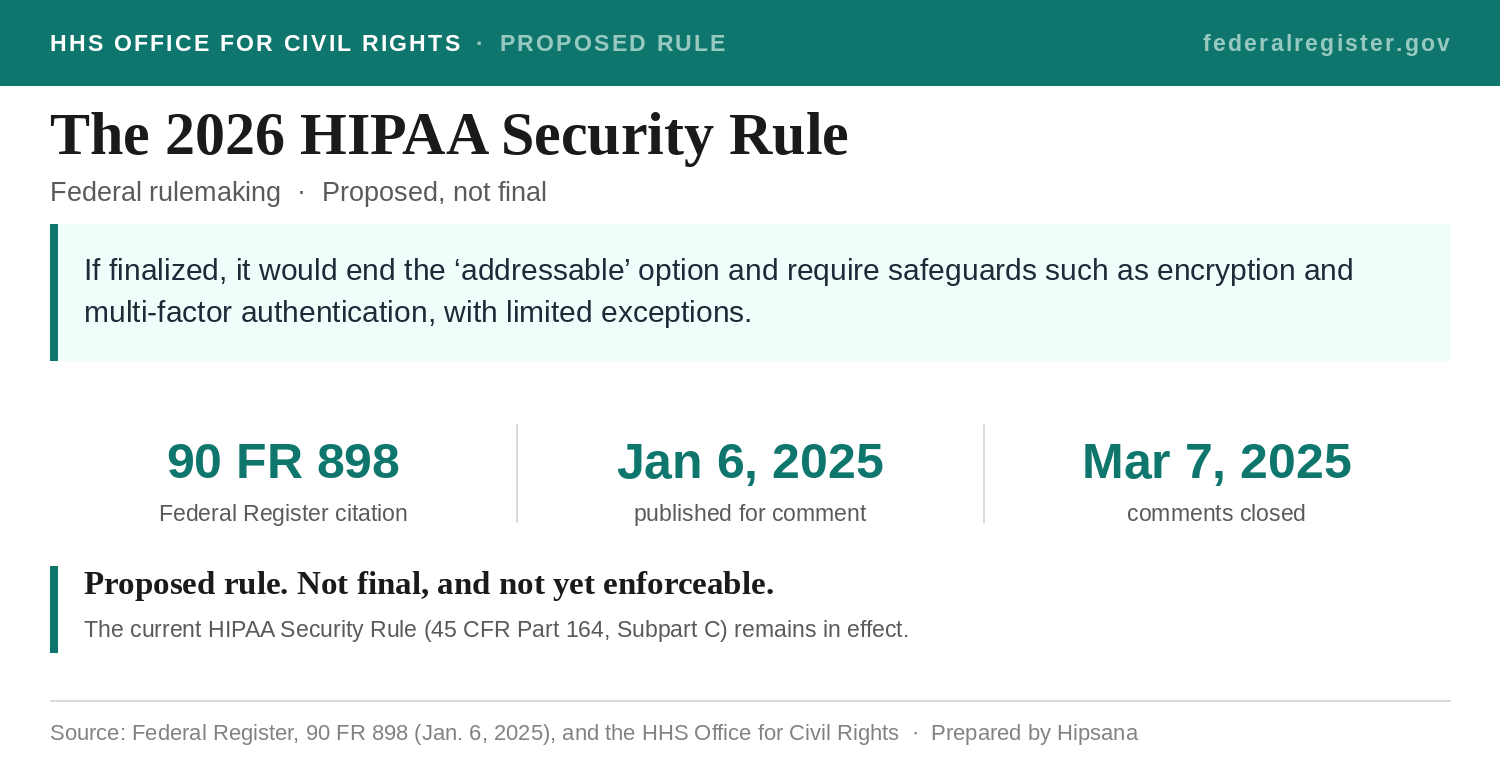
It is not. The Office for Civil Rights, the part of HHS that enforces HIPAA, published the proposed rule in the Federal Register on January 6, 2025, under the title HIPAA Security Rule To Strengthen the Cybersecurity of Electronic Protected Health Information. The public comment period closed on March 7, 2025. Since then the rule has sat in review, and no final version has been issued. Until one is, the current Security Rule is what applies to your practice, and it is what the Office for Civil Rights continues to enforce.
A proposed rule is a draft. It is published so the public can comment, and it binds no one while it is in that stage. The government's own regulatory agenda had pencilled in May 2026 to finalize this one, but that month came and went with nothing published, and there is no confirmed timeline for when, or whether, a final rule will appear.
What the proposal would change
The clearest way to see the proposal is side by side with the rule as it stands today. All of it concerns the same thing the Security Rule has always protected: electronic patient data, what the law calls electronic protected health information, or ePHI. Paper records sit under other HIPAA rules, not this one. Most of these changes are not brand-new ideas. They are existing expectations that the proposal would turn from flexible or unstated into written requirements with specific deadlines.
| Safeguard | The Security Rule today | Under the 2025 proposal |
|---|---|---|
| The "addressable" option | Some specifications are addressable: you assess whether they fit, and may document why you skipped one (45 CFR 164.306(d)). | Removed. Almost all specifications become required, with limited exceptions. |
| Encryption of patient data | Addressable (45 CFR 164.312(a)(2)(iv) and (e)(2)(ii)): assess and implement, or document why not. | Required at rest and in transit, with limited exceptions. |
| Multi-factor authentication | Not named; your risk analysis decides the method. | Required for access to systems holding patient data, with limited exceptions. |
| Vulnerability scanning | Not specified. | Required at least every six months. |
| Penetration testing | Not specified. | Required at least once every 12 months. |
| Technology asset inventory and network map | Not an explicit requirement. | Required, reviewed at least every 12 months and after relevant changes. |
| Network segmentation | Not specified. | Required. |
| Backup and recovery | Contingency plan required (45 CFR 164.308(a)(7)), with no fixed timing. | Keep retrievable copies no more than 48 hours old, and restore critical systems within 72 hours. |
| Compliance audit | No express annual-audit requirement. | Required at least once every 12 months. |
| Vendor (business associate) checks | Have a signed agreement in place. | Verify in writing that each business associate has implemented the required technical safeguards, at least every 12 months. |
Where this comparison comes from. The current-rule column tracks the eCFR: the addressable framework in 45 CFR 164.306, the technical safeguards including encryption in 45 CFR 164.312, and the contingency-plan standard in 45 CFR 164.308. The proposed column is drawn from the HHS Office for Civil Rights NPRM fact sheet and the proposed rule itself in the Federal Register.
Start with the change underneath all the others. Since 2003, some of the rule's safeguards have been labeled addressable. Addressable has never meant optional. It means you either implement the safeguard, adopt an equal alternative, or document why neither is reasonable for you. In practice, many practices treated it as a way to opt out, and encryption is the classic example. Encryption of patient data is addressable today. The proposal would make it required, both for data sitting on your systems and data moving across the internet, with only narrow exceptions. The same logic runs through the rest of the rule: it removes the addressable category and writes the expectations down.
On top of that, the HHS fact sheet lists a set of controls that would become explicit requirements. Multi-factor authentication, the second step beyond a password, would be required for access to systems that hold patient data; we cover that one control on its own in does HIPAA require MFA for a dental practice. Automated vulnerability scans would be required at least every six months, and a deeper penetration test, where someone tries to break in the way an attacker would, at least once a year. Network segmentation, which keeps a breach in one part of your network from spreading to the rest, would be required as well.
Two more would change everyday paperwork. You would have to keep a written inventory of your technology and a map of how patient data moves through it, updated at least once a year and whenever something changes. Your backups would have to meet a clock: retrievable copies no more than 48 hours old, with critical systems restored within 72 hours of an outage. A yearly compliance audit, and a written check that each of your vendors has actually put the required safeguards in place, round out the list.
Underneath every one of these is the same document the rule has always centered on: an accurate, current risk analysis. The proposal does not replace it. It sharpens it, and asks you to base it on that asset inventory and network map. If your risk analysis is solid today, you have a head start on almost everything the proposal would add.
Does this apply to a small dental practice? Yes
This is the part that surprises owners of small practices. There is no carve-out for size. The proposal would apply to every covered entity and business associate. In plain terms, that means any dental practice that bills insurance or files claims electronically, no matter how small. HHS addressed the small-practice burden directly in its regulatory impact analysis and declined to create a size-based exemption. A one-dentist office and a five-hundred-bed hospital would face the same list of requirements. What differs is resources. The hospital has a security team and a budget for this, and most independent practices have neither, which is exactly why the rule would land hardest on the smallest offices.
That is also the heart of the objection from organized dentistry. The American Dental Association has argued that dental practices tend to be small, single-site operations with limited IT support, and that requirements designed around large hospital systems would shift cost and time away from patient care without a dental-specific path to comply. The ADA supports strong cybersecurity. Its position is that this particular proposal is the wrong way to get there.
Where the rule stands, and why it has stalled
The proposal landed at an awkward moment. It was one of the last acts of the prior administration's civil rights office, published days before a change in administration that has prioritized cutting regulations rather than adding them. The coalition seeking withdrawal has leaned on exactly that, arguing the rule runs counter to the current deregulatory agenda. More than a hundred organizations, the American Dental Association included, have asked HHS to pull it back.
At the same time, the Office for Civil Rights is still working through the thousands of public comments it received, and has not withdrawn it. So the honest answer about its future is that nobody outside the agency knows. A final rule could appear roughly as proposed, appear in a narrower form after the comments are weighed, be delayed again, or be withdrawn altogether. Planning that bets everything on one of those outcomes is planning to be wrong.
If you want a fast read on where your foundation stands today, the free HIPAA Scorecard checks ten core Security Rule controls that line up with the issues OCR raises most in enforcement, like your risk analysis and your vendor agreements, then scores your practice and names your biggest gap in about three minutes. It is a starting point, not a full audit: it checks the rule as it stands now, not the proposal, but those are the same controls the proposal would build on.
What a dental practice should do now
Here is the practical way to hold both facts at once. You are not required to comply with a rule that is not final, and you should not spend money chasing requirements that may change. At the same time, almost everything the proposal would require is already either required today or simply good security, so the low-regret move is to get your foundation in order. None of the steps below is wasted effort if the rule is narrowed or never finalized.
This is the document the Office for Civil Rights cites most often after a breach, and it is the base the proposal builds on. If yours is missing or years old, that is the first gap to close.
It is usually already built into the email and practice-management systems you use, often at no extra cost, and the expected safeguard after a breach. The largest health care breach ever reported to HHS, the 2024 Change Healthcare attack that affected about 192.7 million people, began on a remote-access portal that had no multi-factor authentication.
Encryption is built into most modern computers, phones, and software; it usually just needs to be switched on and documented. Turning it on for the devices and email that hold patient data closes one of the most common findings.
Your IT company, cloud backup, billing service, and software vendors each need a business associate agreement. The proposal would also require you to verify they have the safeguards in place, so the agreement is the starting point.
A short inventory of your devices and software, plus a simple note of where patient data lives and moves, is the asset inventory and network map the proposal would ask for, and it makes your risk analysis better today.
This is general information about HIPAA and a proposed federal rule, not legal advice, and the rule's status can change. Before you make compliance decisions based on the proposal, confirm its current status and check with a healthcare attorney or a qualified HIPAA compliance professional.
About the author
Dolev Arama is Hipsana's founder. He's the one behind the Scorecard and the short risk reviews it produces. He is not an attorney, and Hipsana is a publisher and referral service, not a law firm or a healthcare provider. The writing here starts where the rules actually live (HHS, OCR, NIST) and gets checked against their current text before it goes up. Regulatory claims trace back to those sources, and figures name where they come from; anything that can't be verified is labeled rather than asserted. More about Hipsana →
Sources
- U.S. Department of Health and Human Services, Office for Civil Rights, “HIPAA Security Rule To Strengthen the Cybersecurity of Electronic Protected Health Information,” notice of proposed rulemaking, 90 FR 898 (Federal Register, Jan. 6, 2025): published for public comment, comment period closed March 7, 2025, and not finalized as of July 2026.
- HHS Office for Civil Rights, HIPAA Security Rule NPRM fact sheet: the proposed requirements, including removing the “addressable” category, encryption of ePHI, multi-factor authentication, vulnerability scanning at least every six months, penetration testing at least once every 12 months, network segmentation, a technology asset inventory and network map, a 12-month compliance audit, and business associate verification (hhs.gov, accessed July 2026).
- 45 CFR § 164.306 (security standards: general rules, including the “required” versus “addressable” framework at § 164.306(d)) (eCFR, current as of July 2026).
- 45 CFR § 164.312 (technical safeguards, including encryption as an addressable specification at § 164.312(a)(2)(iv) for stored ePHI and § 164.312(e)(2)(ii) for transmitted ePHI) (eCFR, current as of July 2026).
- 45 CFR § 164.308 (administrative safeguards, including the risk analysis requirement at § 164.308(a)(1)(ii)(A) and the contingency plan standard at § 164.308(a)(7)) (eCFR, current as of July 2026).
- 45 CFR § 160.105 (compliance dates: regulated entities have at least 180 days after the effective date of a new or modified standard) (eCFR, current as of July 2026).
- American Dental Association, “ADA urges HHS to withdraw proposed HIPAA cybersecurity rule” and ADA Regulatory Reform comments (ada.org, December 2025): the ADA joined a coalition of more than 100 organizations seeking withdrawal, citing the burden on small, single-site dental practices.
- Executive Order 14192, “Unleashing Prosperity Through Deregulation” (2025), and the federal Unified Agenda entry for this rulemaking (reginfo.gov, RIN 0945-AA22): the rule is designated “Regulatory” under the administration's deregulatory order, its Unified Agenda timetable lists a May 2026 target for final action, and its legal deadline is listed as “None” (accessed July 2026).
- Change Healthcare / UnitedHealth Group: the 2024 ransomware breach, the largest reported to HHS; Change Healthcare notified OCR on July 31, 2025 that approximately 192.7 million individuals were affected, and the intrusion began on a remote-access portal that had no multi-factor authentication (HHS Change Healthcare FAQ and OCR breach portal, plus UnitedHealth Group congressional testimony, accessed July 2026).
Frequently asked questions
Is the 2026 HIPAA Security Rule in effect?
No. It is a proposed rule, published in the Federal Register on January 6, 2025, with the comment period closing that March. As of 2026 there is no final rule, and the current HIPAA Security Rule still applies. The government's May 2026 target to finalize it passed with nothing published, and more than 100 health care organizations, including the American Dental Association, have asked for it to be withdrawn.
Would the proposed rule apply to a small or solo dental practice?
Yes, if it is finalized. There is no exemption for size. The proposal would apply to every covered entity and business associate, and HHS specifically declined to create a small-practice carve-out. A solo dentist would face the same requirements as a hospital system, which is why the proposal would be hardest on small offices with limited IT support.
What are the main changes the proposal would make?
It would remove the "addressable" option and make almost all safeguards required. Encryption of patient data and multi-factor authentication would become mandatory. It would add vulnerability scans at least every six months, penetration testing at least once a year, network segmentation, a written technology inventory and network map, faster backup and recovery targets, a yearly compliance audit, and a written check that vendors have the required safeguards in place.
When would a dental practice have to comply?
Only after a final rule is published, and that has not happened. If one is issued, the proposal sets the effective date at 60 days after publication, with compliance required 180 days after that, for roughly 240 days in total, plus extra time to update vendor agreements. That timeline assumes the rule is finalized as written, which is not guaranteed.
Should I start preparing now even though it is not final?
Preparing the foundation is low-regret. You should not spend money chasing requirements that may change, but most of what the proposal would require, like a current risk analysis, multi-factor authentication, encryption, and vendor agreements, is already required today or simply good security. Getting those in order helps you now and would put you ahead if the rule is finalized. The free HIPAA Scorecard checks those core controls and names your biggest gap in about three minutes; it is a starting point, not a full audit.
Could the rule be changed or dropped before it is final?
Yes. The Office for Civil Rights is still reviewing thousands of public comments, and the current administration has prioritized reducing regulation. A final rule could appear roughly as proposed, appear in a narrower form, be delayed, or be withdrawn. Until the agency acts, the current Security Rule is the one that applies.
Not sure where your practice stands?
The free HIPAA Scorecard checks ten core Security Rule controls and scores your practice out of 100. About three minutes, no cost. A starting point, not a full audit.
Check my practice →