Articles / Records, patients, and staff
A Deceased Patient's Dental Records: Who Can Get Them Under HIPAA (2026)
When a family member asks a dental practice for the records of a patient who has died, HIPAA gives three different answers, and which one applies depends on who is asking. The personal representative of the estate, usually the executor or administrator, is treated as the patient and can get the records relevant to settling the estate. A family member who was involved in the patient's care can receive the information relevant to that involvement, unless the patient had objected. Someone who only held a health-care power of attorney during the patient's life is not automatically entitled to anything after death. Here is how to tell them apart, and what to ask for first. Records after a death are one situation among many in the broader HIPAA duties your practice carries every day.
This article explains who can obtain a deceased patient's records under HIPAA. It is general information, not legal advice for your specific situation. For that, consult a healthcare attorney or a qualified HIPAA compliance professional.
Does HIPAA still protect a patient's records after they die?
It does, for 50 years. The Privacy Rule requires you to protect a deceased patient's records for fifty years following the date of death. Only after that long does the information stop being what HIPAA calls protected health information, the patient data the Privacy Rule guards. In plain terms, a patient passing away does not free you to release the chart to anyone who asks. The same care you owe a living patient's records, you owe a deceased one's, for the rest of most people's working lives and beyond.
Who is the personal representative of a deceased patient?
The personal representative of someone who has died is the person your state's law puts in charge of their estate. Usually that is the executor named in the patient's will, or, if there was no will, the administrator the probate court appoints. In some states, another person authorized under state law, such as a surviving spouse or next of kin, may have that authority instead. HIPAA treats that person as the patient. They stand in the patient's shoes and can get the records relevant to carrying out their duties, which in practice covers what they need to settle the estate. Their authority comes from the estate, not from any medical role, so it does not matter whether they ever helped the patient with health decisions.
Because the authority comes from a court, you can ask to see the court's paperwork. For an estate with a will, that document is called Letters Testamentary. For one without a will, it is Letters of Administration. Either one names the person the court has authorized to act for the estate. In one OCR case, the daughter requesting her late father's records sent the practice a copy of her Letters of Administration along with the request. You are allowed to ask for that proof, or for comparable proof of authority under your state's law, before you release anything.
What about a spouse, a child, or someone with power of attorney?
This is where practices slip. A health-care power of attorney lets someone make medical decisions for a patient while the patient is alive, and during that time it makes them the patient's personal representative for health information. It ends at death. After death, a health-care power of attorney does not by itself prove authority, and HIPAA looks to state law for who may act for the deceased person or the estate, usually an executor or administrator, and sometimes another authorized person. A former power-of-attorney agent holds no special status unless they are also that person. The same is true of being a spouse or an adult child. Relationship alone does not make someone the personal representative. A surviving spouse who is the named executor qualifies, and a surviving spouse who is not may still qualify if state law gives that spouse authority to act for the estate. If not, the spouse may still get records through the involved-family route below. That covers an adult who has died. For a living minor child, a parent is usually the personal representative under a different part of the same rule, which we cover separately.
Can a family member who was involved in the patient's care get records?
Yes, within limits. Separate from the personal-representative rule, HIPAA lets you share a deceased patient's information with a family member, relative, or close friend who was involved in the patient's care or payment for that care before death. Two conditions come with it. You share only the information relevant to that person's involvement, not the whole chart, and you do not share at all if it would go against something the patient had told you they wanted. This route is permission, not a requirement, and it is narrower than what the personal representative gets.
In practice this covers ordinary, humane situations. A sibling asking what happened can be told the circumstances around the death. A family member closing out the estate can be given the billing records they need. What it does not cover is an open-ended request for the entire file from a relative who simply wants to see it.
There is also a quieter path that has nothing to do with the family asking directly. If another dentist or physician is treating a surviving relative and needs the deceased patient's records for that relative's care, say to understand an inherited condition, you can release the relevant records to that provider without an authorization, because disclosures for treatment do not require one. The request comes from the treating provider, and you limit it to what is relevant to the living patient's care.
Who can get a deceased patient's dental records, at a glance
Here is the same logic in one place. When someone asks for a deceased patient's records, the first question to answer is which of these they are.
| Who is asking | What HIPAA allows | What to verify |
|---|---|---|
| The executor or administrator of the estate (the personal representative) | Treated as the patient. Broad access to the records relevant to settling the estate (45 CFR 164.502(g)(4)). | Letters Testamentary, Letters of Administration, or comparable state-law proof of authority. |
| A family member or close friend who was involved in the patient's care or payment | May receive the information relevant to that involvement, unless it goes against the patient's known wishes (45 CFR 164.510(b)(5)). | A reasonable basis that they were involved, and whether the patient ever objected. |
| Someone who only held a health-care power of attorney during the patient's life | Not automatically entitled. The power of attorney ended at death. | Estate authority (Letters or comparable proof), or whether they were involved in the patient's care. |
| A relative or other person with no estate authority and no involvement in care | No general right to the records. | Estate authority, a valid authorization (from the personal representative, or signed by the patient before death), or another HIPAA basis. |
Where each row comes from. A personal representative's authority is set by 45 CFR 164.502(g)(4), the involved-family route by 45 CFR 164.510(b), and the whole framework is laid out in the HHS Office for Civil Rights guidance on a deceased individual's health information.
What OCR has actually done about this
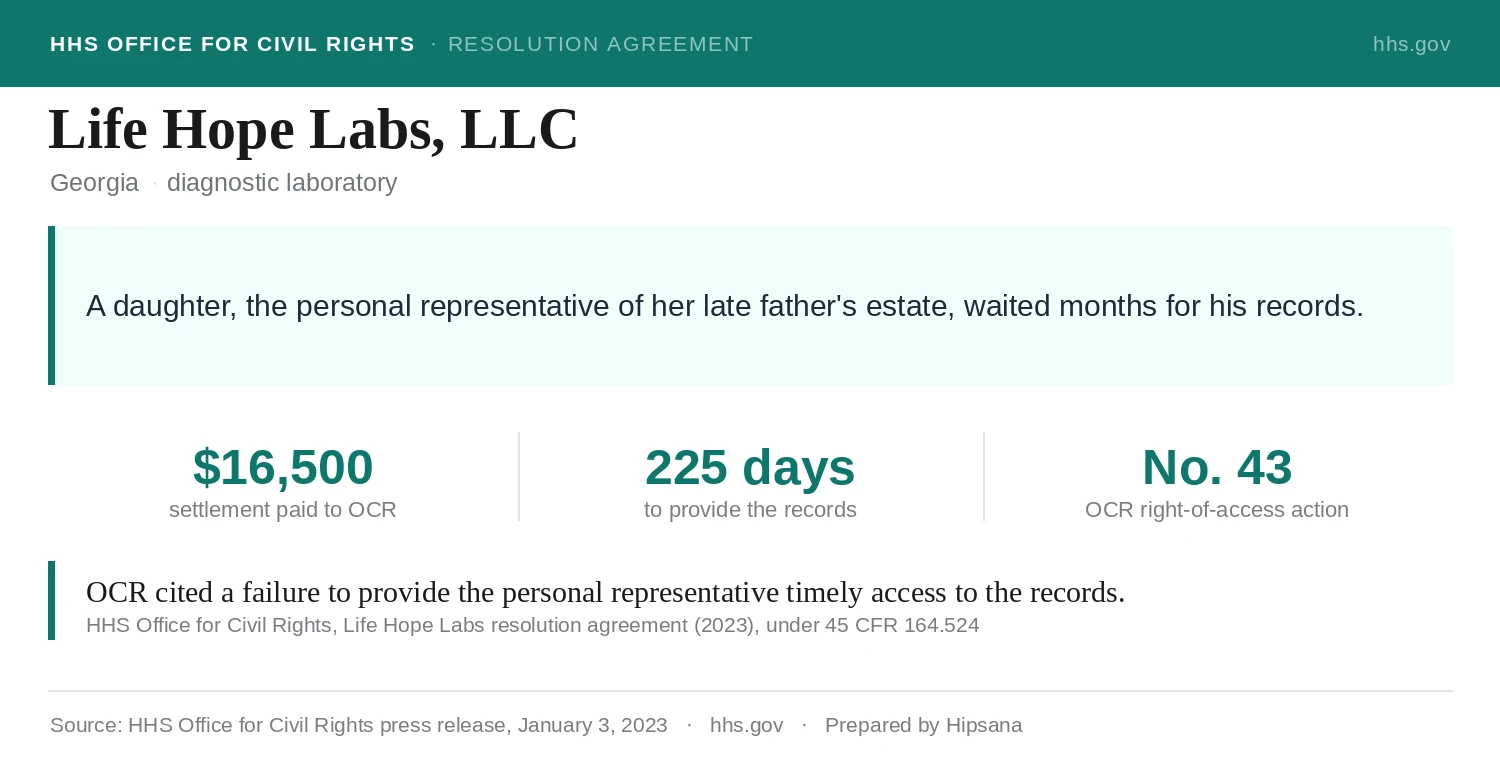
This is not a hypothetical risk. The Office for Civil Rights, the part of HHS that enforces HIPAA, has settled cases over exactly this scenario, both times for the personal representative of a deceased patient's estate. In one, a diagnostic lab in Georgia, Life Hope Labs, took 225 days to send a personal representative the records they had asked for. OCR settled the matter for $16,500, the forty-third action in its initiative on timely records access.
In the other, a Florida primary care practice, Health Specialists of Central Florida, did the same thing to a daughter requesting her late father's records, who had even sent in her Letters of Administration with the request. That one settled for $20,000. Neither practice admitted wrongdoing, and neither failure was exotic. The lesson is plain. Once you have confirmed that the person is the personal representative, their request runs on the same clock as any records request, and being busy or unsure is not a defense. The fulfillment rules, including the thirty-day deadline, are the same ones that apply to a living patient's request.
Handling a request like this correctly is one piece of a front desk that holds up under scrutiny, and the practices that get tripped up are usually the ones whose baseline was shaky to begin with. The free HIPAA Scorecard checks ten core Security Rule controls that line up with the issues OCR raises most, like your risk analysis and your vendor agreements, then scores your practice and names your biggest gap in about three minutes. It does not check how you handle a deceased patient's records, but it shows whether your broader HIPAA foundation is in place.
What a dental practice should do
Most routine requests do not require a lawyer on call. They require a short routine the front desk can follow, plus a clear escalation point for when the proof of authority is not obvious.
A patient's death does not lift HIPAA. Treat the request with the same care you would a living patient's, because the records are still protected.
Personal representative of the estate, an involved family member, or someone with neither claim. The rest of the steps follow from this one answer.
Letters Testamentary, Letters of Administration, or comparable proof of authority under your state's law. It names the person authorized to act for the estate.
Share only what relates to their involvement in the patient's care or payment, and not at all if the patient had asked you to keep it from them.
Once you confirm a personal representative, the timely-access rules apply, including the thirty-day deadline. Do not let the request sit.
A short note of who received the records and the basis for the disclosure protects you if anyone questions the release later.
This is general information about HIPAA, and a deceased patient's records are an area where your state's law also has a say in who counts as the personal representative. Before you release records, confirm who is authorized under your state's law, and when you are not sure, check with a healthcare attorney or a qualified HIPAA compliance professional.
About the author
Dolev Arama is Hipsana's founder. He's the one behind the Scorecard and the short risk reviews it produces. He is not an attorney, and Hipsana is a publisher and referral service, not a law firm or a healthcare provider. The writing here starts where the rules actually live (HHS, OCR, NIST) and gets checked against their current text before it goes up. Regulatory claims trace back to those sources, and figures name where they come from; anything that can't be verified is labeled rather than asserted. More about Hipsana →
Sources
- 45 CFR § 164.502(g) (personal representatives), including § 164.502(g)(1) (a covered entity must treat a personal representative as the individual) and § 164.502(g)(4) (an executor, administrator, or other person with authority over a deceased individual or the estate is treated as the personal representative for protected health information relevant to that representation) (eCFR, current as of July 2026).
- 45 CFR § 164.502(f) (a covered entity must protect a deceased individual's protected health information for 50 years following death), with the definition of “protected health information” at 45 CFR § 160.103, which excludes information about a person deceased more than 50 years (eCFR, current as of July 2026).
- 45 CFR § 164.510(b)(1) and § 164.510(b)(5) (a covered entity may disclose a deceased individual's relevant protected health information to a family member or other person who was involved in the individual's care or payment for care, unless inconsistent with the individual's prior expressed preference) (eCFR, current as of July 2026). Paragraph (b)(5) was added by the 2013 HIPAA Omnibus Rule, 78 FR 5566.
- 45 CFR § 164.506 (treatment, payment, and health care operations may be disclosed without authorization), the basis on which a deceased patient's records may be provided to a provider treating a surviving relative (eCFR, current as of July 2026).
- U.S. Department of Health and Human Services, Office for Civil Rights, “Health Information of Deceased Individuals” and “Personal Representatives” guidance (hhs.gov, accessed July 2026): the personal representative of a decedent is the executor, administrator, or other person authorized under state law to act for the decedent or the estate, and stands in the individual's shoes; involved family members who are not personal representatives may receive relevant information under § 164.510(b).
- HHS Office for Civil Rights, FAQ on whether a health-care power of attorney allows access to a patient's records (hhs.gov, accessed July 2026): a health-care power of attorney makes a person the patient's personal representative for health information while the patient is alive.
- HHS Office for Civil Rights, FAQ on how a deceased individual's family can obtain records relevant to their own health care (hhs.gov, accessed July 2026).
- HHS Office for Civil Rights, “Lab Pays $16,500 Settlement to HHS, Resolving Potential HIPAA Violation over Medical Records Request” (Life Hope Labs, LLC), with the resolution agreement and corrective action plan (hhs.gov, January 2023): the personal representative of a deceased patient's estate waited 225 days for the records; OCR cited a failure to provide timely access under 45 CFR § 164.524; the settlement is not an admission of liability.
- HHS Office for Civil Rights, “HHS Civil Rights Office Resolves HIPAA Right of Access Investigation with $20,000 Settlement” (Health Specialists of Central Florida, Inc.), with the resolution agreement and corrective action plan (hhs.gov, December 2022): a daughter acting as personal representative of her deceased father, who submitted Letters of Administration, waited about five months for the records.
Frequently asked questions
Can a family member get a deceased patient's dental records?
It depends on who they are. The executor or administrator of the estate is treated as the patient and can get the records relevant to settling the estate. A family member who was involved in the patient's care can receive the information relevant to that involvement, unless the patient had objected. A relative with neither claim has no general right to the records without a valid authorization or another HIPAA basis.
Does a power of attorney let someone access a deceased patient's records?
Not on its own, once the patient has died. A health-care power of attorney lets someone make decisions while the patient is alive, and it ends at death. After death, who can act is determined by state law, usually the executor or administrator of the estate, and sometimes another authorized person. A former power-of-attorney agent has no special right to the records unless they are also the estate's personal representative or were involved in the patient's care.
Who is the personal representative of a deceased patient?
It is the person your state's law authorizes to act for the estate, usually the executor named in the will or, if there was no will, the administrator appointed by the probate court, and in some states another authorized person such as a surviving spouse. HIPAA treats that person as the patient for the records relevant to their duties. You can ask to see their Letters Testamentary, Letters of Administration, or comparable proof of their authority.
How long does HIPAA protect a deceased patient's records?
Fifty years from the date of death. During that time you must protect the records the same way you would a living patient's. After fifty years, the information is no longer protected health information under HIPAA, though state retention rules and good practice may still apply.
Do we have to verify that someone is really the executor?
Yes, when their authority is not already known to you. HIPAA requires reasonable steps to verify the identity and authority of someone claiming to act for the estate before you release records, and it lets you rely on documents that appear valid on their face. The usual proof is Letters Testamentary or Letters of Administration from the probate court, or comparable proof of authority where state law authorizes someone else, naming the person authorized to act for the estate. Verifying also protects you from releasing records to the wrong person.
A relative just wants to know how their loved one died. Can we tell them?
Often yes. If the person was involved in the patient's care or payment for care, you may share the information relevant to that involvement, which can include the circumstances around the death, unless the patient had asked you not to. Keep it to what relates to their involvement rather than opening the entire chart.
Not sure where your practice stands?
The free HIPAA Scorecard checks ten core Security Rule controls and scores your practice out of 100. About three minutes, no cost. A starting point, not a full audit.
Check my practice →